
Creativity Has Lost Its Confidence
One day at Global Marketer Week in Stockholm. Eleven sessions. One uncomfortable truth: we're spending more on marketing than ever — and getting less back. Here's what needs to change.
This year, WFA's Global Marketer Week 2026 was held in Stockholm, and we took the opportunity to bring a big group from Nepa and spent one intense day listening to some of the sharpest marketing leaders in the world.
Between sessions, we discussed what we were hearing and how it connected to what we see in our own data every day. By the end of the afternoon, we had landed on a few shared conclusions. This is my attempt to capture them — not as a conference recap, but as a point of view on where marketing is heading and what to do about it.
Four themes from Global Marketer Week 2026 that every CMO should act on
1. The creative crisis is real — and it's measurable
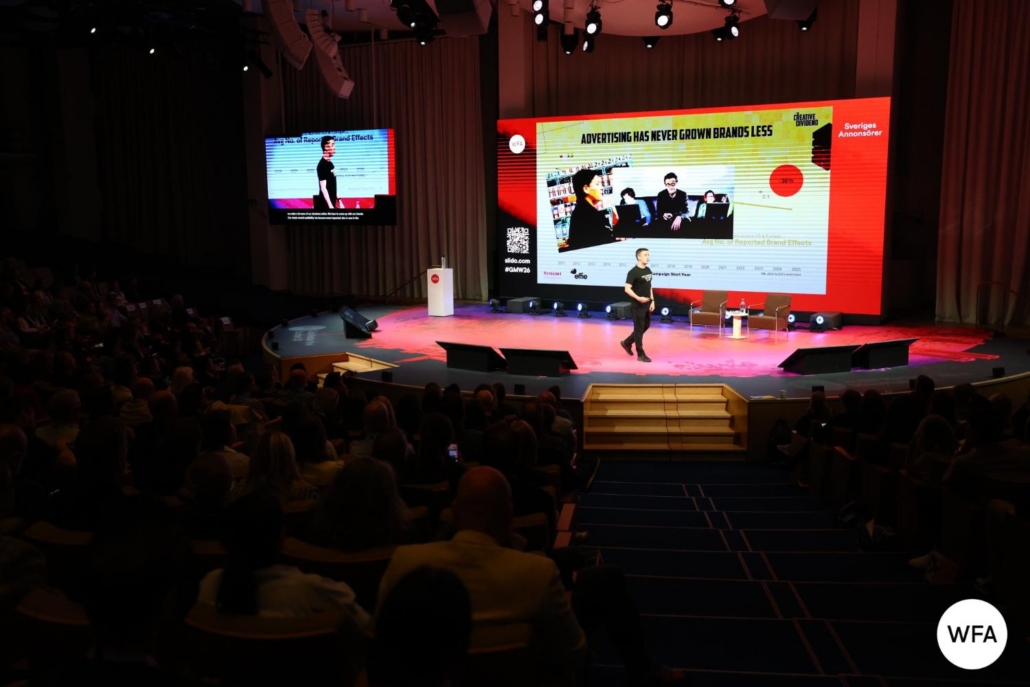
Andrew Tindall from System1 brought data that should make every marketer uncomfortable. Over the past 15 years, ad spend has increased by roughly 30%, yet brand effects — awareness, equity, differentiation — have been declining. We're spending more, and getting less back.His research, linking a thousand Effie campaigns to System1's creative data across a quarter of a million consumers, identifies four levers that predict profit growth: emotion (without it, media spend doesn't convert), distinctiveness (brand characters beat celebrities; audio branding beats visual clutter — "you can close your eyes, but you can't close your ears"), showmanship (earning attention from the 95% not yet in market) and consistency (which delivers 4x higher ROI).Yet the industry is moving in the opposite direction: less emotional, fewer characters, fewer jingles, more celebrities, more short-term objectives. Only 17% of global campaigns qualify as "growth engines." Four in ten are what Tindall calls "busy work."WFA's Stephan Loerke reinforced this: only 47% of global marketing capability programs even include creative excellence. And Arla's Patrick Hansson gave a bracingly honest example — after extensive creative training, his team still produced what he called "quite generic" advertising with "milking cow pornography." The breakthrough came only when they restructured their insight organization into a genuine strategic partner and built a systematic learning loop across every creative asset and touchpoint.
What we think about this at Nepa: This is the area we probably feel most strongly about. We see the same patterns across thousands of campaign evaluations — the campaigns that drive the highest liking and business impact are almost always the ones that trigger strong emotional responses. Neutral emotions are barriers to both recall and action. It's why we developed our Brand Touch and Emotion Palette frameworks and why we've invested in combining survey-based campaign measurement with AI-powered creative analysis. The opportunity for most brands isn't to spend more on media. It's to make the creative work harder — and that starts with measuring what actually drives response, systematically, campaign after campaign.
2. AI is rewriting the customer journey — faster than most brands realize
Isabel Perry from DEPT delivered the day's most urgent call to action. 47% of people say AI shapes brand trust. 69% of Google searches are now zero-click. And 48% of AI prompts represent entirely new consumer behaviors.
Her thesis: the customer journey is now half human, half AI. Brands have two audiences — one human, one algorithmic — and you need to market to both. She calls it B2A: business to agent. Influence the agents through generative engine optimization, equip them with AI-native design systems, and connect to them through distributed applications.
P&G's Taya de Guajardo confirmed the shift from the advertiser side: they're doing the work to "fit the algorithm so that we appear when there's LLMs that have to bring our products." And Mars' Gülen Bengi described using connected data and AI agents — one team affectionately named theirs "the crystal ball" — to cut innovation cycles from years to four months.
What we see in our own data: This connects directly to findings from our "Age of Influence" consumer study. AI is already a top-6 source of inspiration for Gen Z, outranking traditional media like TV. Almost 70% of Gen Z and Millennials trust AI answers, with one in four trusting them fully. AI shaped one in ten of Gen Z's most recent consumer goods purchases, and for those who did use AI, every third purchase ended with them choosing the product AI recommended.
We also see that every tenth consumer changes their intended brand during the purchase process — salience under pressure, as we call it. The implication is that mental availability matters more than ever, but it now has to work in two directions: for human minds and for algorithmic ones. Understanding category entry points in an AI context — what situations and prompts trigger recommendations — becomes a critical strategic question. And brands with strong, verified, structured data will be the ones that get surfaced. Trust, authenticity and credibility are your edge.
The question for most marketers isn't whether this is happening. It's whether they've started mapping their own journeys through this lens — and adjusting their brand and content strategies accordingly.
3. Fundamentals win — especially in chaos
In a day themed around transformation, the loudest message was about what doesn't change.
P&G's Taya de Guajardo anchored her talk in three principles from 189 years of brand building: understand real life, deliver real superiority, invest in real people. The methods evolve — P&G now uses connected home sensors and machine learning to observe behavior rather than relying on what consumers say — but the philosophy is constant: start with the consumer.
Mars' Gülen Bengi put it crisply: "The fundamentals of brand building do not change. Brands need to know what they stand for, be distinctive, differentiated, and consistent over time." Arla's Patrick Hansson echoed it as his single piece of advice: "Understand the core fundamentals of marketing. It will always start with that."
And when Tindall was asked whether AI is enhancing or distracting from creativity, his answer was disarming: "Everyone talks about AI slop, but no one talks about human slop. We've been making shit ads for a hundred years."
What we think about this at Nepa: The fundamentals aren't just principles — they're measurable. Brand strength, distinctiveness, emotional resonance, consistency — these can all be tracked and acted on continuously. That's the core of what we do with brand tracking, brand asset optimization and campaign evaluation. But what changes is the context in which these fundamentals need to be delivered: more fragmented media, more AI-mediated touchpoints, more pressure on budgets. The brands that win are those that build a systematic connection between what they measure and how they brief, create and optimize.
4. Sustainability is a growth lever — if you get specific
The final theme challenged the notion that sustainability has fallen off the agenda. Andrew Stephen from Oxford's Saïd Business School presented data showing that up to 10% of brand value comes from consumers' perceptions of sustainability credentials, and products with verified sustainability credentials see a meaningful sales uplift.
Asahi's Preeti offered a practical playbook: map each brand to its credibly achieved sustainability milestones, filter for brand DNA fit, then filter for local consumer relevance. "Not every brand needs to stand for every sustainability theme. It needs to be authentic, selective." And she shared a simple but powerful accelerator: connecting sustainability KPIs to leadership bonuses. "Voilà, the shift just accelerated exponentially."
Opella's Alberto Hernandez reframed the entire question: sustainable marketing is about behavior change, and behavior change is a growth engine. By helping consumers make better self-care choices, they drive category expansion. People with high health literacy show 70% higher purchasing intent toward brands that helped them understand their condition.
The connection to AI is critical here too. As Andrew Stephen pointed out, brands that don't communicate sustainability credibly risk being excluded from LLM recommendations altogether — while those making unverifiable claims get downweighted.
What we think about this at Nepa: We see this as a measurement challenge as much as a communication one. Which sustainability cues actually drive preference in your category? Where do they differentiate versus simply meet the norm? Brand tracking and campaign evaluation can quantify this — and turn sustainability from a vague ambition into a data-driven positioning lever.

Five things to prioritize — and where to start
Based on what we heard and what we discussed during the day, here's what I'm taking with me:
1. Make emotions a KPI. The data is unambiguous: emotional resonance predicts profit. Add structured emotional measurement to your campaign evaluations and pre-tests. Tools like our Brand Touch and Emotion Palette exist specifically for this — to move beyond "liked/disliked" and understand which emotional responses actually drive recall, liking and action. If you're not measuring how your creative makes people feel, you're missing the most important signal.
2. Map your journey through an AI lens. Understand where conversational AI already shapes decisions in your category. What does ChatGPT say when someone asks for a recommendation? Our "Age of Influence" study can help you benchmark where AI sits in your consumers' path to purchase — and whether your brand is positioned to be discovered by both humans and algorithms.
3. Protect and scale your distinctive brand assets. Characters, sounds, visual codes — these are strategic infrastructure, not decoration. Brand asset optimization helps you identify which elements truly drive recognition and which are just inherited habit. In a world where consistency delivers 4x ROI, knowing what to keep and what to evolve is a competitive advantage.
4. Build learning loops, not one-off reports. Connect your brand tracking, campaign measurement and creative testing into a continuous system. Each campaign should build a playbook, not just a case study. The difference between Arla's early struggles and their later creative improvement came down to exactly this: systematic insight feeding back into the creative process.
5. Lead with evidence on sustainability. Don't greenhush, but don't greenwash either. Measure which sustainability messages resonate in your category, track them over time, and use the data to make the internal business case. In a world where LLMs are also evaluating your credibility, structured and verifiable claims aren't just good ethics — they're good strategy.
If any of these themes resonate — whether it's creative effectiveness, AI-shaped consumer journeys, or the question of how to make fundamentals work harder in a more complex world — we'd love to continue the conversation.
Ulrika Berg, Marketing Director, Nepa
Image credits: #GMW26 @WFA
Published on: 24TH APR 2026