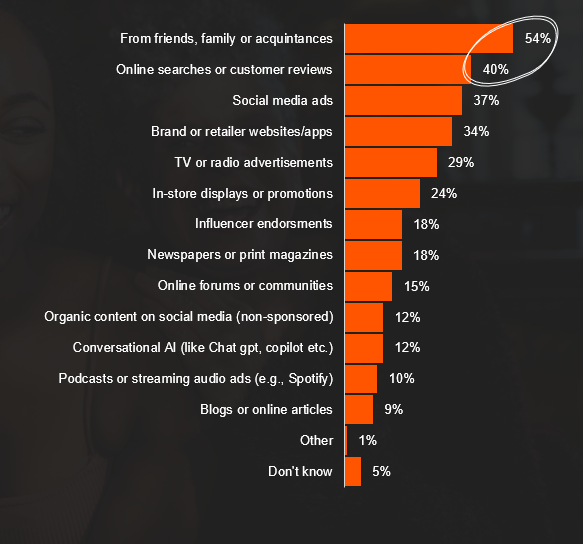
That places personal recommendations ahead of online search and customer reviews (40%), social media advertising (37%), brand and retailer websites (34%), television and radio advertising (29%), and newspapers and print (18%).
The implication for media planning is significant. Word-of-mouth is rarely given a budget line, yet it outreaches every paid channel in the study. This is not because paid media fails to work — it is because social recommendation is where many purchase decisions are validated, particularly after a consumer has been reached through a paid channel.
The pattern that emerges from the data is a two-step process: consumers encounter a product through a feed, an ad, or editorial content, then consult someone they trust before deciding. Paid media initiates the consideration. Personal recommendation closes it.
Brands that understand this do not treat word-of-mouth as a by-product of campaign activity. They design products, experiences, and service interactions with referability in mind — recognising that a recommendation from a trusted person carries more persuasive weight than equivalent paid exposure.
The data suggests that marketing effectiveness cannot be measured through paid channels alone. A brand’s organic recommendation rate is a legitimate efficiency indicator, and it is shaped by product quality, purchase experience, and post-purchase satisfaction as much as by advertising.
The Age of Influence is a consumer research study by Nepa. The Swedish sample comprises 1,372 respondents aged 16–74, surveyed between 27 June and 18 July 2025.