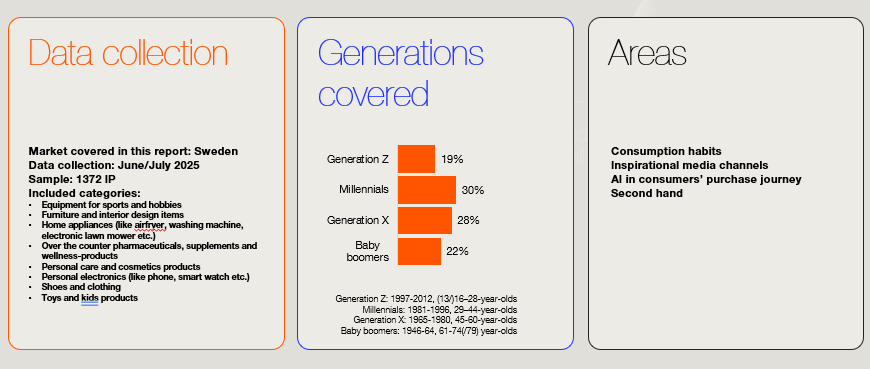
Earlier this year, Nepa hosted a webinar based on our latest study, The Age of Influence – Understanding what drives purchase decisions today and tomorrow. Drawing on fresh data from more than 1,300 Swedish consumers across categories such as personal care and cosmetics, shoes and clothing, home appliances and personal electronics, we explored how media, social influence and AI are reshaping the path to purchase across generations.
Designed for brands investing 20M+ per year in media who need board‑level proof of marketing’s impact on both short‑term results and long‑term competitive advantage.
This article zooms in on one of the most important shifts from that session: how AI is quietly rewriting the consumer journey – from the moment people start looking for ideas, to the point where they choose a specific brand and retailer.
If you would like to go deeper into the data and hear the full discussion, you can watch our on-demand webinar about The Age of Influence here. It is a useful companion to this article, especially if you want to bring the findings into internal presentations or leadership discussions.
Introduction: when discovery becomes delegated
Over the past decade, marketers have learnt to navigate an increasingly fragmented media landscape. Social feeds, search, influencers and retail media have all re-shaped how people discover and choose products. Generative AI now introduces a more fundamental shift.
Instead of browsing, scrolling and comparing, consumers can ask a single question: “What should I buy?” The answer no longer comes from a single brand message or a single channel, but from an AI system that parses thousands of signals – reviews, product data, content and past behaviour – and returns a curated shortlist.
Nepa’s study, conducted in Sweden in June–July 2025 among 1,372 consumers, shows just how quickly this behaviour is scaling. AI is no longer a fringe tool for tech-savvy early adopters; it is becoming an everyday companion in the purchase journey – particularly for younger generations.
For CMOs and senior marketers, this raises a critical question: What happens to brand building when the decision is increasingly mediated by algorithms rather than individuals?
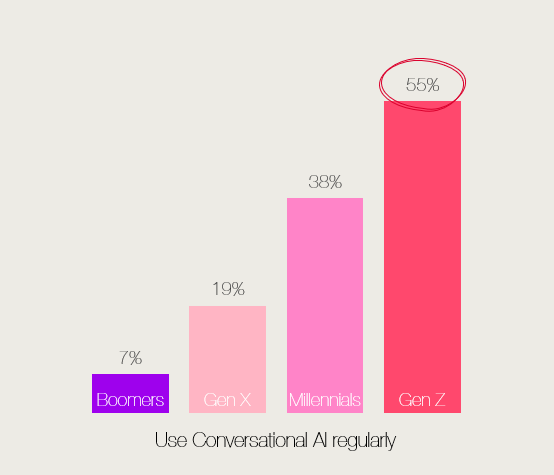
Surprising no one – Gen Z is leading the use of Conversational AI
The consumer journey is being rewritten
Traditional models describe the journey from awareness to consideration to purchase as a sequence of human decisions, influenced by media, peers and in-store touchpoints. AI compresses and redistributes these stages.
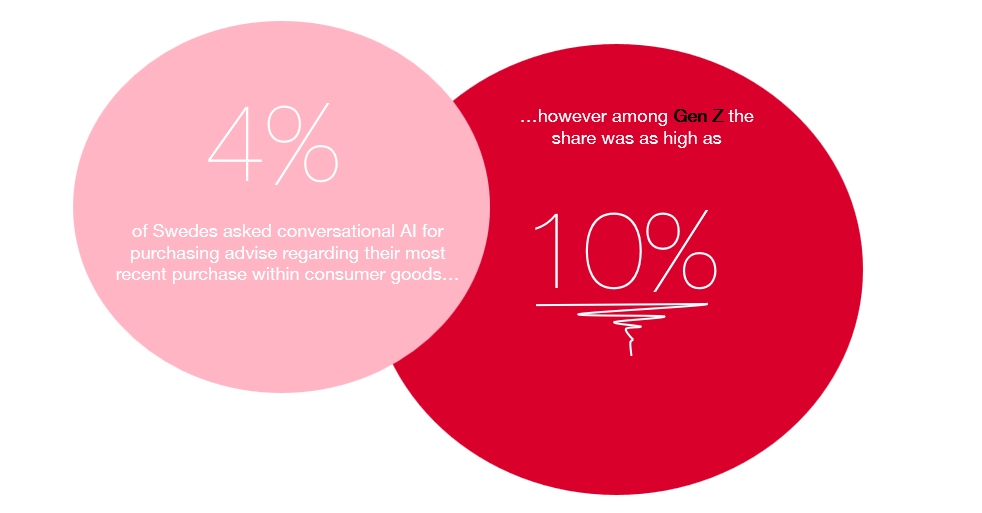
In our data, 4% of Swedish consumers used conversational AI when making their most recent purchase within consumer goods, but this jumps to 10% among Gen Z. In other words, for one in ten Gen Z purchases, a chatbot or assistant was directly involved in shaping the outcome.
Equally important is the psychological shift. When consumers outsource parts of their research to AI, they are not just speeding up the process; they are altering who they perceive as the expert. The assistant becomes an always-available advisor that can:
- translate needs into product attributes
- filter overwhelming choice into a handful of options
- resolve uncertainty in moments where brand preference is still fluid
This is why we describe the journey as being “re-coded”. AI is not just another channel; it is a decision layer that sits between the consumer and the market.
AI as a new source of inspiration
The first place we see this new decision layer is in the inspiration and research phase.
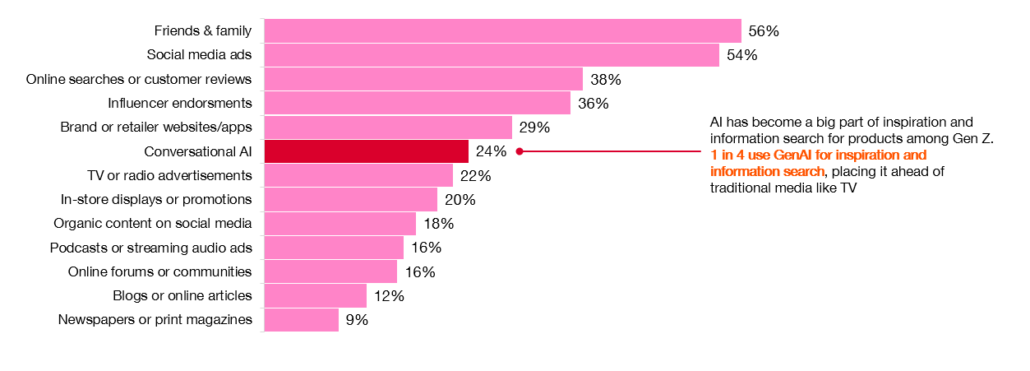
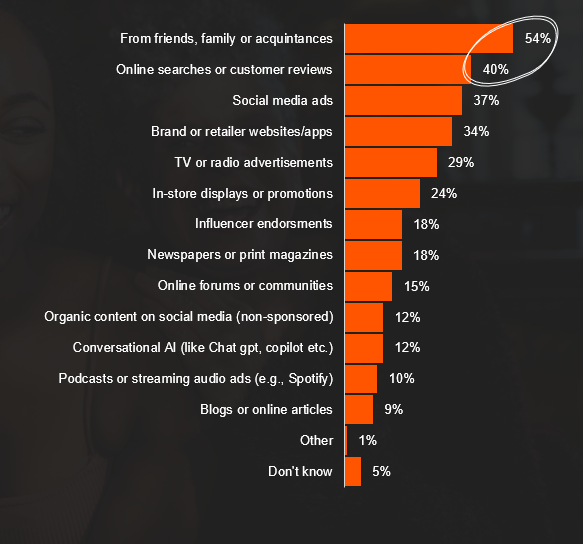
Among Gen Z, AI has already broken into the top tier of discovery channels. For this generation, conversational AI is now the sixth most important source of inspiration and information about new products and services, used by 24% – ahead of traditional media such as TV and radio advertising (22%). Friends and family still lead at 56%, followed by social media ads (54%) and online searches or customer reviews (38%), but AI has clearly joined the mainstream mix.
Sources for inspiration and information about new products and services – Gen Z
Usage is strongly generational:
- 55% of Gen Z say they use conversational AI regularly, compared with 38% of Millennials, 19% of Gen X and just 7% of Boomers.
- Trust levels are strikingly high: around two-thirds of Gen Z and Millennials say they trust the answers AI gives them, and one in four state they trust those answers fully.
The surprise?
They have a very high trust in the answers given
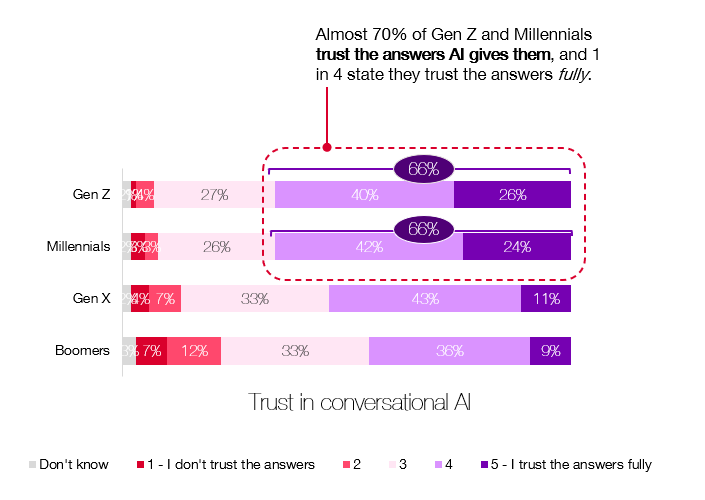
This combination of high usage and high trust is crucial. Search engines and social platforms are also widely used, but consumers have learnt to treat them with a degree of scepticism – scanning multiple sources, checking reviews, comparing prices. With AI, especially conversational interfaces, the interaction is more intimate and more linear. Many users see the output not as “results to investigate” but as “advice to follow”.
In categories that involve higher stakes or complexity, AI’s role is even more visible. When we look at the most recent purchases:
- 11% of consumers who bought home appliances used conversational AI as part of their research.
- 11% did the same for personal electronics.
These are categories where specifications, price points and trade-offs can be confusing. AI’s promise – “Explain this to me in simple terms, given my needs and my budget” – neatly addresses this pain point.
Used conversational AI to research during their most recent purchase – by category
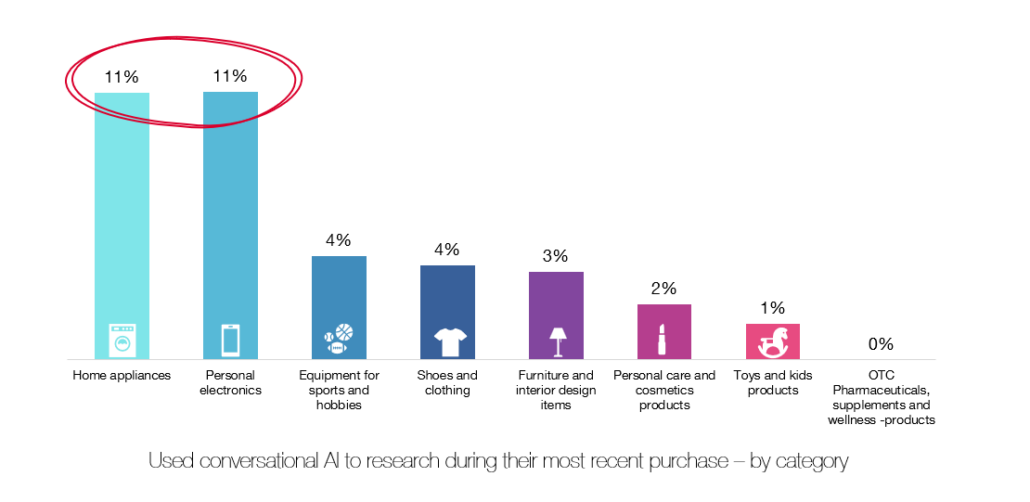
For marketers, the implication is clear: AI has become a default research companion for a growing share of consumers, particularly younger ones, and especially in complex, high-involvement categories.
When AI becomes the decision filter
If AI were only an inspiration tool, its impact would be meaningful but manageable. Our data shows, however, that once people bring AI into the process, it frequently becomes the decisive filter.
Among consumers who used conversational AI during their most recent purchase:
- 66% asked about products on a general level – for example, which type of product suits their needs.
- 48% asked specifically about a particular product.
- 44% asked where to buy the product – pushing AI directly into the realm of channel and retailer selection.
- 39% asked for product recommendations.
- Most strikingly, 36% ultimately purchased the product suggested by AI.
AI usage during most recent purchase
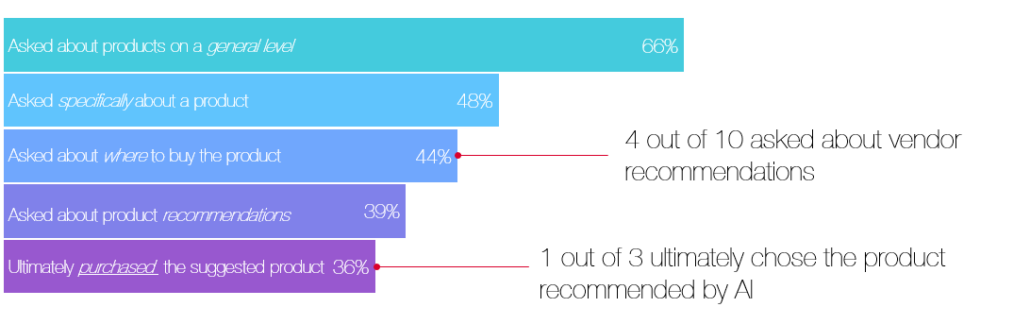
In other words, when consumers consult an assistant, roughly one in three end up buying the AI-recommended option. AI is not just surfacing possibilities; it is actively curating the shortlist and closing the sale.
This has two profound consequences:
First, brand preference is increasingly tested in real time. Consumers may enter the journey with a vague idea of what they want, but the conversation with AI can validate, redirect or overturn that intent within minutes.
Second, the locus of influence shifts from messaging to metadata. Traditional marketing tries to strengthen preference through campaigns. AI-mediated decisions hinge far more on whether the brand is visible, comprehensible and credible within the assistant’s knowledge graph.
For senior marketers, this means your share of recommendation inside AI systems could become as critical as your share of voice in paid media.
Strategic implications for brands
So how should brands respond to an environment where algorithms act as gatekeepers?
Optimise for AI-driven discovery, not just search
Most organisations have some level of SEO discipline. Few have a formal strategy for AIO – AI optimisation.
As conversational AI becomes a front door to product discovery, the objective shifts from “ranking on page one” to being included in the handful of options an assistant is willing to recommend. That requires:
- Clear, structured product data: specifications, benefits, pricing, availability, compatibility and use-cases need to be described in machine-readable formats, not just marketing prose.
- Consistent brand narratives across touchpoints: AI draws on multiple sources – your website, retailer listings, reviews, articles. Discrepancies between them can create confusion or trigger the model to exclude your brand in favour of clearer alternatives.
To maximize discoverability in conversational AI, brands should focus on:
- Structured, accurate product data
Use clean, standardized product descriptions with keywords (ingredients, features, certifications).
Publish machine-readable metadata (schema markup, GS1 standards). - Third-party validation
Get certifications (Fair Trade, Organic, Carbon Neutral, Cruelty-Free).
AI often prioritizes products with trusted references (NGO sites, certification bodies). - Strong digital presence across sources AI pulls from
Retailer websites, Amazon, Google Shopping feeds.
Reviews on trusted platforms (positive sentiment influences AI ranking).
Coverage in credible editorial sources (consumer reports, sustainability lists, press mentions). - Transparency & storytelling in data form
If your product is sustainable/ethical, make sure it’s clearly written in structured text, not just as a vague marketing tagline.
Example: Instead of “eco-friendly,” use: “Packaging made from 80% post-consumer recycled plastic, certified by XYZ.” - Price competitiveness + availability
AI will often filter based on “best value” or “in-stock near me.”
Keeping pricing and inventory feeds accurate is crucial. - Integration with retail ecosystems
Ensure your product is indexed correctly in marketplaces (Amazon, Walmart, Target, Instacart, etc.), since many AI assistants pull data from there.
- Customer review optimization
Encourage authentic reviews with details (AI scrapes these).
More specific, value-aligned reviews (“smells amazing, cruelty-free, recyclable packaging”) increase the chance AI highlights your product.
Treat product data as a first-class marketing asset
The study underlines that categories with high research needs – such as home appliances and personal electronics – are where AI usage is currently most pronounced. In these categories, the quality of your product information becomes a competitive differentiator.
Marketing teams should work with product, ecommerce and data colleagues to ensure:
- attributes and benefits are exhaustively documented
- FAQs and troubleshooting information are available in text form
- content is kept up to date across owned, retailer and marketplace environments
If AI cannot confidently answer detailed consumer questions about your product, it is less likely to recommend it.
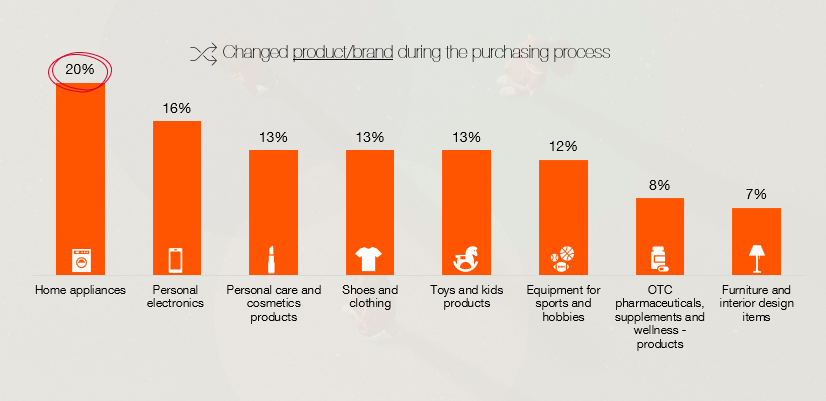
Changed product/brand during the purchasing process
Understand the questions consumers are asking AI
To influence AI recommendations, brands need to reverse-engineer the category entry points that consumers use in their prompts. Are people asking:
- “What is the best washing machine for a small flat?”
- “Which running shoe is best for knee problems?”
- “What are sustainable gift ideas for a 10-year-old?”
Each of these frames the decision space differently and may favour different brands or attributes. Marketers should invest in qualitative research, prompt analysis and social listening to map these question spaces – and then shape content, product positioning and partnerships around them.
Strengthen mental availability in an AI-mediated world
AI may act as a filter, but human memory still matters. Our broader study on media influence shows that friends and family remain the top source of inspiration for Swedes, and social media ads, reviews and influencers continue to play major roles in shaping preference before AI is ever consulted.
This means brand building does not disappear; it changes focus:
Continue to invest in reach and salience across relevant channels to ensure your brand is top-of-mind when consumers formulate their prompts.
- Continue to invest in reach and salience across relevant channels to ensure your brand is top-of-mind when consumers formulate their prompts.
- Use creative that reinforces distinctive assets – names, colours, taglines – that AI systems are likely to encounter and recognise across the web.
- Build and maintain trust through credible claims, transparent practices and consistent experiences. The more consumers already believe in your brand, the less likely they are to blindly accept an AI recommendation that points elsewhere.
Reframe measurement and KPIs
Finally, marketers will need new metrics alongside traditional funnel KPIs. These could include:
- Share of AI recommendations in key prompts and scenarios (tracked through structured testing with major assistants).
- Coverage and completeness scores for product and brand data across channels.
- AI-attributable sales, where consultation with an assistant can be identified or approximated in the path to purchase.
Early movers who start to measure and optimise for these dimensions will gain an advantage as AI-mediated decision-making moves from edge case to norm.
Conclusion: influencing people – and the systems that advise them
The Age of Influence shows that AI is no longer a theoretical disruptor; it is already shaping a meaningful share of consumer decisions, particularly among younger shoppers and in complex categories. One in ten Gen Z purchases in consumer goods now involves conversational AI, and when people do consult an assistant, more than a third end up buying the recommended product.
In this environment, marketing is no longer only about persuading individuals. It is also about equipping algorithms with the right signals – data, content, proof points – so that when consumers ask, “What should I buy?”, your brand is one of the options that confidently surfaces.
To dive deeper into the findings – and to see the full discussion around media polarisation and brand salience under pressure – watch our on-demand webinar on The Age of Influence here. It is a concise way to bring your wider team up to speed on how AI is reshaping the purchase journey, and what your brand needs to do next.
Trusted by +300 leading brands across all industries










CASE STUDIES
See how customers use brand tracking to grow better

Launching new concepts in such a competitive, fast-moving category requires more than a good idea – it demands precise, trustworthy insights
READ CUSTOMER STORY

Turning crisis into clarity – how Dafgårds used insight to regain consumer trust. Read the full success story in this post.
READ CUSTOMER STORY
case studies
GANT
GANT trusts Nepa to help it grow
Through a strong partnership, Nepa equips GANT with real-time insights, driving smarter decisions and sustained growth.
VARNER
Telenor
Sinebrychoff
Kellogg’s
Fashion Retailer